Keep observation separate from explanation
Write down what is directly visible before naming a fault. “Localised warm region in the lower part of the module” is an observation. “Failed bypass diode” is an explanation that may need additional evidence. Separating those statements prevents a model’s suggested class from becoming a diagnosis merely because it appears in a report field.
A useful finding record has distinct fields for observed pattern, candidate cause, evidence quality, reviewer confidence and recommended verification. It also allows “unresolved” as an honest outcome. Forcing every image into a defect category creates false certainty and can send maintenance teams to replace functioning equipment.
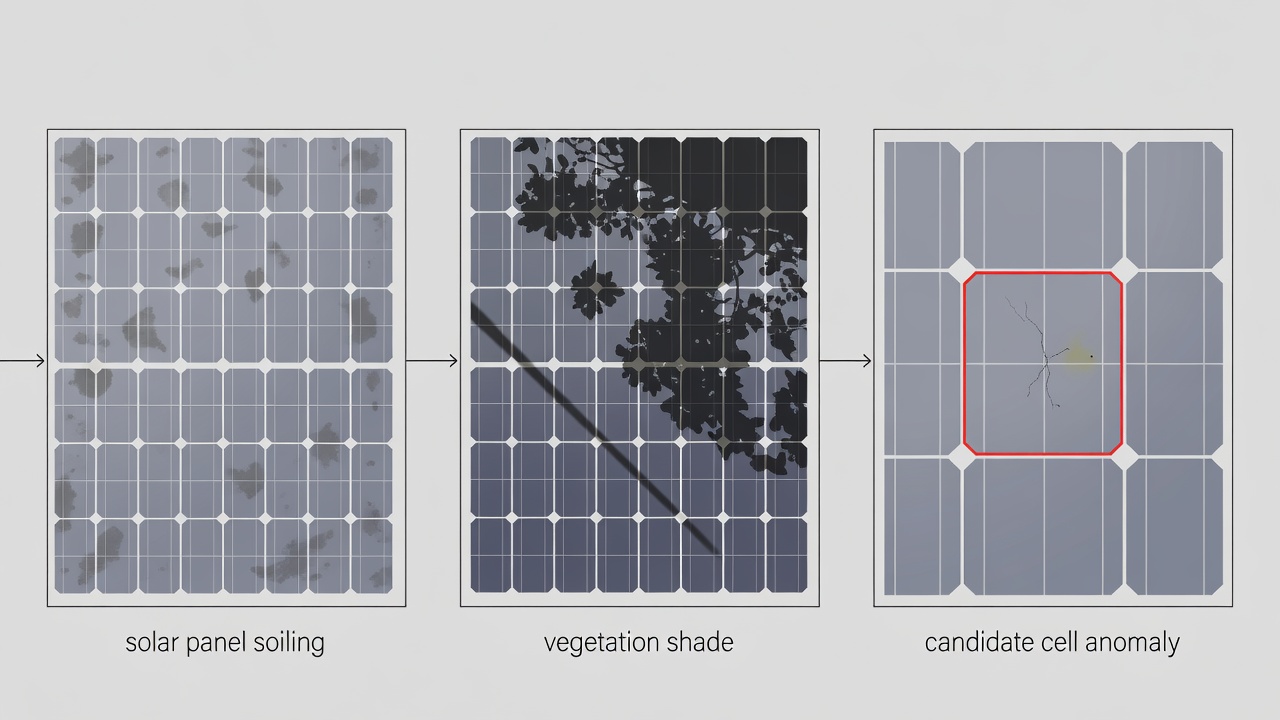
Understand the common look-alikes
Visible contamination can obscure cells and may be associated with thermal differences, but appearance alone does not establish the resulting electrical impact. Vegetation, adjacent structures and temporary objects can cast shadows. Reflections can create bright thermal regions. Module edges, mounting details and stitched-image seams may also look unusual to a model trained on cleaner examples.
Physical damage presents another challenge. A visible crack in glass is different from a microcrack in a cell, and ordinary drone photography does not reveal every internal defect. Electroluminescence and electrical testing can provide information that a visible or thermal survey cannot. The correct response is to name the limitation, not to imply that an unflagged module is necessarily free of defects.
Ask what the model was actually trained to do
“AI-powered” describes an approach, not an inspection capability. Establish whether the tool locates modules, segments thermal regions, classifies known patterns or estimates a priority. Those are different tasks. Request the class definitions, relevant validation conditions and known exclusions. A detector may work well on one module layout yet struggle with another technology or an unfamiliar camera configuration.
Review performance using data representative of your site. Precision concerns how many flagged examples are relevant; recall concerns how many relevant examples were found. Neither measure should be quoted without explaining the test set, definition of a positive finding and evaluation method. An overall accuracy figure can hide poor detection of rare but important conditions.
Challenge each candidate finding
Begin with the original image and the mapped asset. Confirm that the marker is on the intended module, not a neighbouring panel. Compare visible context and thermal evidence captured close enough in time to be meaningful. Look for shade, debris, reflections, recent cleaning, plant-state changes and repeated patterns across a row or string.
Then ask what would disprove the proposed cause. A different viewing angle may expose a reflection. A later comparable capture may show whether a pattern persists. A qualified electrical investigation may distinguish between competing explanations. Choose verification according to the suspected mechanism and site risk, rather than running every possible test on every flagged panel.
Review what the system did not flag
A queue of detections only shows the model’s positive selections. Inspect a sample of unflagged images as well, including difficult conditions and different site sections. Otherwise, missed findings remain invisible to the review process. Track disagreements between reviewers and the algorithm, and distinguish genuine model errors from ambiguous images or inconsistent labelling.
Keep the model version, processing settings and review date with the result. If a later release changes a classification, preserve the original decision history rather than silently replacing it. Comparable review records make it possible to investigate whether apparent changes come from equipment condition, acquisition differences or the software itself.
Close with a useful status
A practical review can end in several states: rejected as an artefact, accepted as an observed anomaly, awaiting verification, or confirmed through an appropriate investigation. Do not collapse these into a single “defective” flag. Maintenance planners need to know whether they are dispatching a technician to diagnose, monitor, clean, repair or replace.
For example, a repeated local thermal pattern with a clean visible surface may justify targeted investigation, but it still does not identify every possible internal cause. Record the proposed next task and the evidence that would change the decision. That makes the AI output useful without giving it authority it has not earned.
Sources and further reading
- IEA PVPS: Review of Failures of Photovoltaic Modules.
- NIST AI Risk Management Framework: risk management and evaluation principles, not a PV inspection certification.
- IEC catalogue: IEC 61215 series concerns module design qualification; it is not a substitute for diagnosing a field finding.