Separate consequence from certainty
Two findings can have similar model confidence and very different operational implications. Conversely, a weakly understood finding can still deserve urgent assessment if the possible consequence is serious. Keep potential consequence, evidence confidence and next action as separate fields. A single score can conceal the reason a planner should act.
Safety concerns belong within the site’s established escalation process. An image reviewer should identify and communicate a possible hazard without improvising isolation instructions. Qualified, authorised personnel decide the appropriate controls and response. Routine performance optimisation must not compete with a credible safety concern simply because it has a clearer financial estimate.
Use a priority matrix as a conversation aid
A matrix makes assumptions visible, but it is not a substitute for engineering judgement. Define categories with the asset owner and maintenance provider before applying them at scale. Distinguish the urgency of verification from the urgency of repair: a prompt diagnostic visit may be justified even when replacement is not yet supported.
| Potential consequence | Evidence confidence | Planning response | Closure evidence |
|---|---|---|---|
| Possible safety hazard | Any; uncertainty recorded | Escalate for qualified assessment under the site procedure. | Responsible-person decision and completed safety actions. |
| Material operational concern | Corroborated finding | Schedule targeted diagnosis and assess the remedy. | Test results and post-work operational check. |
| Possible performance issue | Limited or conflicting evidence | Gather the evidence needed to decide. | Repeat capture or diagnostic conclusion. |
| Minor condition issue | Well documented | Bundle with suitable planned work or monitor. | Condition record and review trigger. |
Make the work order specific
A technician should not have to infer the task from a red marker on an aerial map. Include the asset identifier, access information, original images, observed pattern, candidate explanation and requested verification. State whether the assignment is to investigate or to perform an already authorised remedy. Include the reviewer’s reasoning and the limitations of the evidence.
Attach relevant operational context: inverter state, previous findings, known repairs, warranty constraints and any planned outage. Preserve a stable finding identifier so updates in the maintenance system can be traced back to the inspection record. Where multiple findings concern the same underlying issue, link them rather than creating duplicate visits.
Estimate impact without inventing precision
Maintenance planning often needs a view of production impact, cost and access constraints. Use monitoring data and an appropriate analysis method where available. State the baseline, time period and assumptions. A thermal contrast or count of flagged modules alone is not enough to establish annual energy loss or a guaranteed financial return.
For uncertain findings, compare the cost and value of the next information-gathering step. A targeted test may prevent an unnecessary replacement, while a repeat capture may resolve a weather-related ambiguity. This is not an argument for delaying serious concerns; it is a way to make routine decisions proportionate to the available evidence.
Plan access, parts and dependencies
Group compatible routine tasks where that reduces repeated mobilisation, but check the consequences of postponement. Access conditions, competent staffing, electrical permissions, spare-part compatibility and manufacturer requirements can all affect the schedule. A replacement module must be assessed for suitability rather than selected solely because its dimensions appear to match.
Record which decisions need owner approval and which can be made by the maintenance provider. Warranty claims may require particular photographs, serial numbers or test records before equipment is removed. Preserve those records early so the inspection evidence remains useful beyond the immediate work order.
Close the loop with comparable evidence
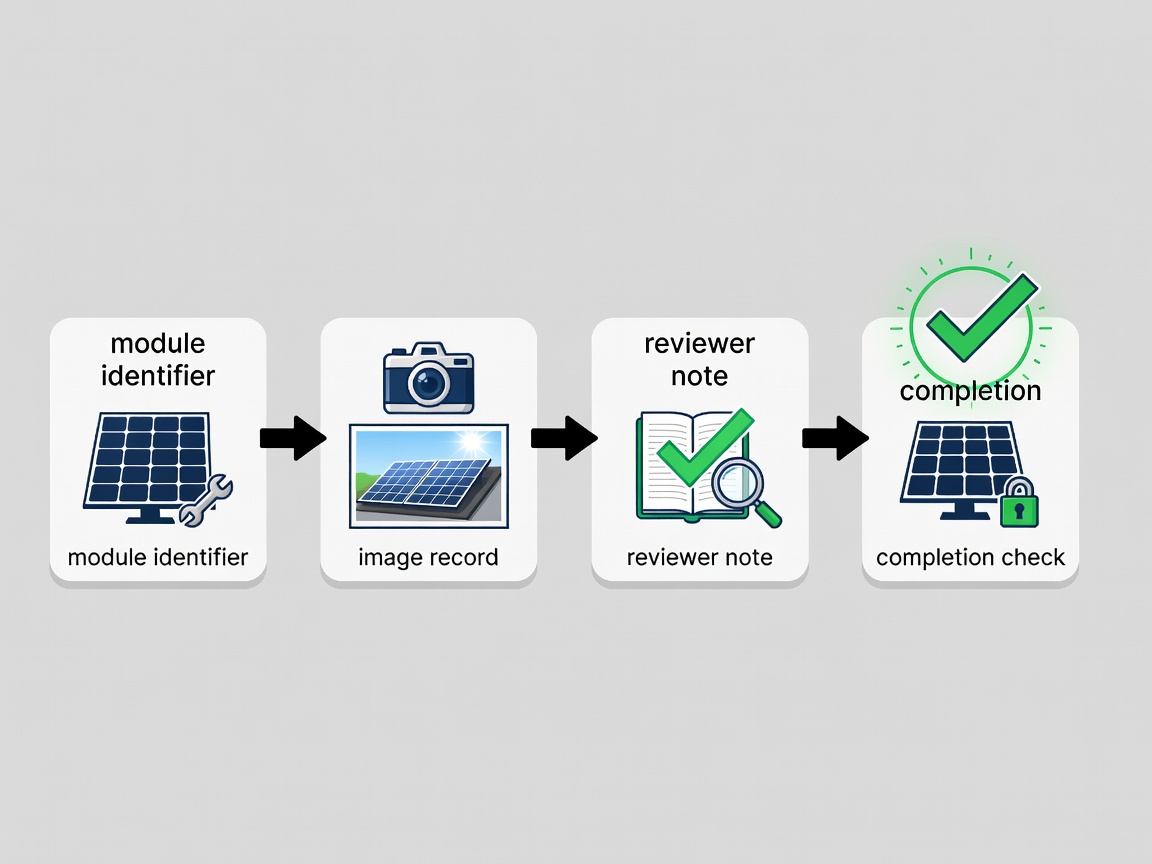
“Work completed” does not always mean “finding resolved.” Record what was actually done and verify the relevant outcome. Cleaning may need a condition check; an electrical repair may require appropriate tests and an operational review. Repeat thermal imagery is most informative when acquisition conditions and interpretation methods are sufficiently comparable.
Retain unresolved outcomes instead of forcing closure. If a pattern persists, update the explanation and next step. Feed confirmed findings, rejected detections and recurring capture problems back into the inspection process. The maintenance queue then becomes a learning record: it shows not only what the AI found, but which evidence led to a useful, defensible intervention.
Sources and further reading
- NREL: Best Practices for Operation and Maintenance of Photovoltaic and Energy Storage Systems.
- IEC catalogue: IEC 62446-1 and IEC 62446-2 address PV documentation, testing, inspection and maintenance topics.
- IEA PVPS: technical reports on photovoltaic reliability and performance.